Skin tumor biology

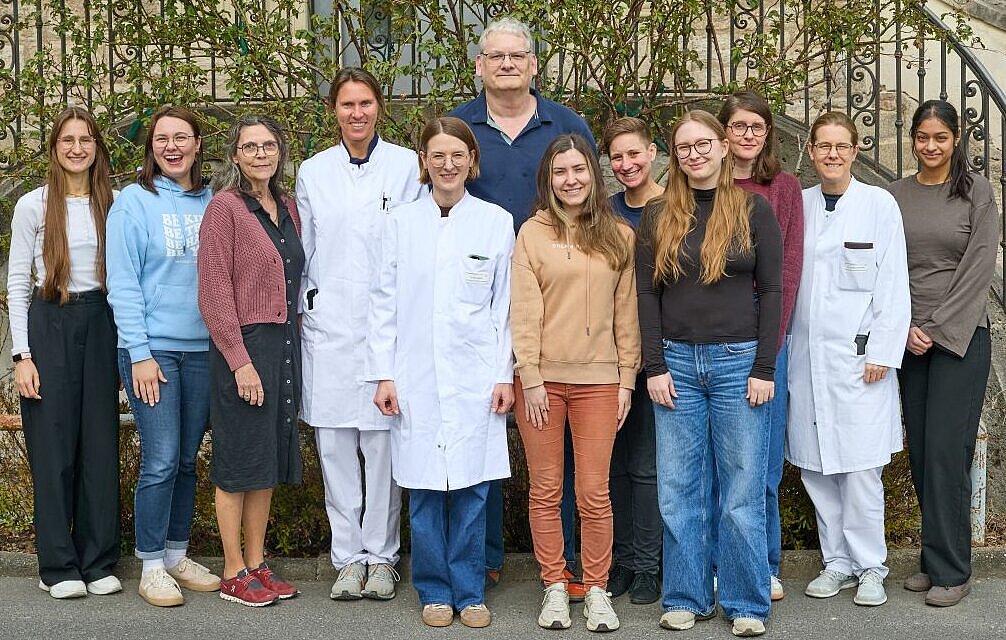
Schrama / Wobser group
Experimental translational projects are carried out in close collaboration with the translational Dermato-Oncology working group led by Dr. Valerie Glutsch.
For years, there has also been close scientific collaboration between the Comprehensive Cancer Center (CCC) Mainfranken and the Center for Personalized Medicine (ZPM) Würzburg. Some research ideas are also explored in collaboration with international scientific partners and through clinical registries (ADO, EORTC).
Our research focuses on three different types of skin tumors: melanoma, cutaneous lymphomas, and Merkel cell carcinoma.
Melanoma
Skin tumors are prevalent due to the high exposure of skin cells to mutation-inducing UV radiation. While melanoma is less common than other skin cancers, it poses a greater risk as it is more likely to metastasize, leading to higher mortality rates. Melanomas originate from melanocytes, the pigment-producing skin cells, and exhibit a remarkable number of genetic alterations characteristic of UV-induced tumors.
One research focus of our group is to analyze the impact of various genetic mutations on the tumor, such as whether they are necessary for tumor development or proliferation, whether they may affect the efficacy of therapy, or whether they are bystander mutations without a decisive effect on the tumor cells.
Furthermore, the accumulation of mutations within a signaling pathway suggests its significance for the tumor cells. Identifying relevant mutations and pathways is crucial not only for a deeper understanding of tumor development, but can also contribute to the development of new therapies or the optimization of existing ones.
Cutaneous lymphoma
Similarly, we are attempting to identify factors that influence the development, proliferation, and survival of cutaneous lymphomas (cutaneous B-cell and T-cell lymphomas). Our molecular and clinical data on cutaneous marginal zone lymphoma and cutaneous follicular B-cell lymphoma, in contrast to cutaneous diffuse large B-cell lymphoma, have contributed significantly in recent years to a better understanding and more precise classification of indolent and aggressive cutaneous B-cell lymphomas. In addition to somatic mutations, oncogenic fusions—as well as epigenetic alterations in cutaneous T-cell lymphomas—have proven to be of central importance for the pathogenesis of cutaneous lymphomas. These tumor-promoting changes offer a broad field for novel therapeutic targets.
A particular focus of our research is on cutaneous T-cell lymphomas. To account for the clonal diversity present in cutaneous T-cell lymphomas and to overcome primary/secondary resistance mechanisms, we are particularly interested in evaluating combinatorial therapeutic approaches designed to meaningfully complement already approved targeted therapy strategies.
Another area of interest for our research group is the improvement of diagnostics for cutaneous lymphomas—particularly in distinguishing them from benign inflammatory skin diseases—and the identification of translationally relevant prognostic markers that influence therapy management in clinical practice. In international collaborative projects, various approaches are being pursued in this area (molecular investigations incorporating single-cell analyses, artificial intelligence (AI)).
Merkel cell carcinoma
However, the principal focus of our research efforts for several years has been the study of Merkel cell carcinoma, a rare and particularly aggressive form of skin cancer. Merkel cell carcinoma gained broader attention in 2008 when it was discovered that a previously unknown virus from the polyomavirus group can be detected in the majority of Merkel cell carcinoma cases. This virus was subsequently named the Merkel cell polyomavirus (MCPyV). Our research has demonstrated that the tumor cells from Merkel cell carcinoma patients, in which the Merkel cell polyomavirus is integrated, rely on the expression of the viral oncogenic proteins known as the T-antigens. The interaction between the large T-antigen and the cellular retinoblastoma protein, which lifts the cell cycle blockade, is particularly crucial for the growth of these tumor cells. Additionally, we have found that phosphorylation of the large T-antigen at a specific site is necessary for its growth-promoting effect. Given the difficulty in directly inhibiting the viral proteins, we are currently focusing on identifying the cellular proteins required for the expression and phosphorylation of the T-antigen, with the aim of developing targeted therapies in the future.
The origin of Merkel cell carcinoma
Merkel cell carcinomas can be divided into two distinct subgroups based on their association with the Merkel cell polyomavirus (MCPyV). Merkel cell carcinomas linked to MCPyV have relatively few genetic mutations, while the virus-negative subgroup exhibits a high number of mutations characteristic of UV-induced skin tumors. The exact cellular origin of both MCPyV-positive and virus-negative Merkel cell carcinomas remains unclear. However, our analysis of combined tumors with Merkel cell carcinoma and epithelial components suggests that MCPyV-positive Merkel cell carcinomas may develop from trichoblastomas (a hair follicle tumor), while virus-negative Merkel cell carcinomas may originate from squamous cell carcinomas. This indicates that, contrary to previous assumptions, both subtypes could have an epithelial cell of origin. We plan to further investigate and validate this hypothesis using various experimental models.
Methods
The tumor biology research laboratory employs a range of experimental techniques, including organoid models and in-vitro cultures, to analyze the effects of genetically modified tumor cells or inhibitors. These methods encompass qRT-PCR, flow cytometry, immunoblotting, immunochemical staining, time-lapse microscopy, genetic manipulations (overexpression, knockdown or knock out via Crispr/cas9), and cell-based assays. In collaborative projects, the range of methods is expanded to include next-generation sequencing (NGS), single-cell RNA sequencing (scRNA-seq), spatial transcriptomics, and the integration of artificial intelligence (AI), among other techniques.
Selected publications
Thiem, A., S. Hesbacher, H. Kneitz, T. di Primio, M. V. Heppt, H. M. Hermanns, M. Goebeler, S. Meierjohann, R. Houben and D. Schrama (2019). "IFN-gamma-induced PD-L1 expression in melanoma depends on p53 expression." J Exp Clin Cancer Res 38(1): 397.
Schrama, D., E. M. Sarosi, C. Adam, C. Ritter, U. Kaemmerer, E. Klopocki, E. M. König, J. Utikal, J. C. Becker and R. Houben (2019). "Characterization of six Merkel cell polyomavirus-positive Merkel cell carcinoma cell lines: Integration pattern suggest that large T antigen truncating events occur before or during integration." Int J Cancer 145(4): 1020-1032.
Wobser, M., A. Weber, A. Glunz, S. Tauch, K. Seitz, T. Butelmann, S. Hesbacher, M. Goebeler, R. Bartz, H. Kohlhof, D. Schrama and R. Houben (2019). "Elucidating the mechanism of action of domatinostat (4SC-202) in cutaneous T cell lymphoma cells." J Hematol Oncol 12(1): 30.
Maurus K, Appenzeller S, Roth S, Brändlein S, Kneitz H, Goebeler M, Rosenwald A, Geissinger E, Wobser M (2020). “Recurrent Oncogenic JAK and STAT Alterations in Cutaneous CD30-Positive Lymphoproliferative Disorders.” J Invest Dermatol. 140(10):2023-2031.
Kervarrec, T., M. Aljundi, S. Appenzeller, M. Samimi, E. Maubec, B. Cribier, L. Deschamps, B. Sarma, E. M. Sarosi, P. Berthon, A. Levy, G. Bousquet, A. Tallet, A. Touzé, S. Guyétant, D. Schrama and R. Houben (2020). "Polyomavirus-Positive Merkel Cell Carcinoma Derived from a Trichoblastoma Suggests an Epithelial Origin of this Merkel Cell Carcinoma." J Invest Dermatol 140(5): 976-985.
Houben, R., M. Ebert, S. Hesbacher, T. Kervarrec and D. Schrama (2020). "Merkel Cell Polyomavirus Large T Antigen is Dispensable in G2 and M-Phase to Promote Proliferation of Merkel Cell Carcinoma Cells." Viruses 12(10).
Kervarrec, T., M. Samimi, S. Hesbacher, P. Berthon, M. Wobser, A. Sallot, B. Sarma, S. Schweinitzer, T. Gandon, C. Destrieux, C. Pasqualin, S. Guyétant, A. Touzé, R. Houben and D. Schrama (2020). "Merkel Cell Polyomavirus T Antigens Induce Merkel Cell-Like Differentiation in GLI1-Expressing Epithelial Cells." Cancers (Basel) 12(7).
Wobser M, Roth S, Appenzeller S, Kneitz H, Goebeler M, Geissinger E, Rosenwald A, Maurus K (2021). “Oncogenic Mutations and Gene Fusions in CD30-Positive Lymphoproliferations and Clonally Related Mycosis Fungoides Occurring in the Same Patients.” JID Innov. 1(3):100034.
Wobser M, Roth S, Appenzeller S, Houben R, Schrama D, Goebeler M, Geissinger E, Rosenwald A, Maurus K (2021). “Targeted Deep Sequencing of Mycosis Fungoides Reveals Intracellular Signaling Pathways Associated with Aggressiveness and Large Cell Transformation.” Cancers. 13(21):5512.
Houben, R., S. Hesbacher, B. Sarma, C. Schulte, E. M. Sarosi, S. Popp, C. Adam, T. Kervarrec and D. Schrama (2022). "Inhibition of T-antigen expression promoting glycogen synthase kinase 3 impairs merkel cell carcinoma cell growth." Cancer Lett 524: 259-267.
Kervarrec, T., S. Appenzeller, M. Samimi, B. Sarma, E. M. Sarosi, P. Berthon, Y. Le Corre, E. Hainaut-Wierzbicka, A. Blom, N. Benethon, G. Bens, C. Nardin, F. Aubin, M. Dinulescu, M. L. Jullie, Á. Pekár-Lukacs, E. Calonje, S. Thanguturi, A. Tallet, M. Wobser, A. Touzé, S. Guyétant, R. Houben and D. Schrama (2022). "Merkel Cell Polyomavirus‒Negative Merkel Cell Carcinoma Originating from In Situ Squamous Cell Carcinoma: A Keratinocytic Tumor with Neuroendocrine Differentiation." J Invest Dermatol 142(3 Pt A): 516-527.
Wobser M, Schummer P, Appenzeller S, Kneitz H, Roth S, Goebeler M, Geissinger E, Rosenwald A, Maurus K (2022). “Panel Sequencing of Primary Cutaneous B-Cell Lymphoma.” Cancers . 27;14(21):5274.
Houben, R., P. Alimova, B. Sarma, S. Hesbacher, C. Schulte, E. M. Sarosi, C. Adam, T. Kervarrec and D. Schrama (2023). "4-[(5-Methyl-1H-pyrazol-3-yl)amino]-2H-phenyl-1-phthalazinone Inhibits MCPyV T Antigen Expression in Merkel Cell Carcinoma Independent of Aurora Kinase A." Cancers (Basel) 15(9).
Houben, R., B. Celikdemir, T. Kervarrec and D. Schrama (2023). "Merkel Cell Polyomavirus: Infection, Genome, Transcripts and Its Role in Development of Merkel Cell Carcinoma." Cancers (Basel) 15(2).
Wobser, M, S. Appenzeller, S. Roth, C. Siedel, M. Goebeler, E. Geissinger, A. Rosenwald and K. Maurus (2024). “Oncogenic alterations in KIR3DL1 in cutaneous acral CD8+ lymphoproliferative disorder.” Br J Dermatol. 191(5):816-822.
Kervarrec, T., S. Appenzeller, A. Tallet, M. L. Jullie, P. Sohier, F. Guillonneau, A. Rütten, P. Berthon, Y. Le Corre, E. Hainaut-Wierzbicka, A. Blom, N. Beneton, G. Bens, C. Nardin, F. Aubin, M. Dinulescu, S. Visée, M. Herfs, A. Touzé, S. Guyétant, M. Samimi, R. Houben and D. Schrama (2024). "Detection of wildtype Merkel cell polyomavirus genomic sequence and VP1 transcription in a subset of Merkel cell carcinoma." Histopathology 84(2): 356-368.
Kervarrec, T., S. Appenzeller, S. Gramlich, E. Coyaud, K. Bachiri, R. Appay, N. Macagno, A. Tallet, C. Bonenfant, Y. Lecorre, J. Kapfer, S. Kettani, N. Srinivas, K.C. Lei, A. Lange, J.C. Becker, E.M. Sarosi, H. Sartelet, A. von Deimling, A. Touzé, S. Guyétant, M. Samimi, D. Schrama and R. Houben (2024). “Analyses of combined Merkel cell carcinomas with neuroblastic components suggests that loss of T antigen expression in Merkel cell carcinoma may result in cell cycle arrest and neuroblastic transdifferentiation.” J Pathol 264(1): 112-124.
Wobser, M., Goebeler M., A. Rosenwald and K. Maurus (2025). „Topical ruxolitinib for treatment of mycosis fungoides and lymphomatoid papulosis.” Br J Dermatol. 193(3):563-564.
Liv, T., A. Touzé A, D. Schrama, S. Guyétant, M. Samimi, M.T. Tetzlaff, B.A. Wood, P.W. Harms and T. Kervarrec (2026). “RB1 inactivation in cutaneous carcinomas.” Histopathology 88(4):769-789
Members of the research group
Büke Celikdemir (PhD candidate)
Email: celikdemir_b@ukw.de
Phone: +49 931 201-26190
Marlies Ebert (technical assistance)
Email: ebert_m4@ukw.de
Phone: +49 931 201-26752
Dr. rer. nat. Sonja Hesbacher
Email: hesbacher_s@ukw.de
Phone: +49 931 201-26752
Eva-Maria Sarosi (technical assistance)
Email: sarosi_e@ukw.de
Phone: +49 931 20126752
Dr. rer. nat. David Schrama
Email: schrama_d@ukw.de
Phone: +49 931 20126756
Prof. Dr. med. Marion Wobser
Email: wobser_m@ukw.de
Phone: +49 201-26718