International Collaboration Beyond the Laboratory
For more than 15 years, researchers at the Institute of Clinical Neurobiology of the University Hospital Würzburg (UKW) and the University of the Sunshine Coast (UniSC) in Queensland, Australia, have been working together to better understand how nerve cells communicate. Their latest joint project, funded by the Queensland–Bavaria Collaborative Research Program, aims to develop three-dimensional, animal-free artificial synapses based on human induced pluripotent stem cells (iPSCs). The innovative models are expected to provide new insights into neurological disorders while reducing the need for animal-based research.
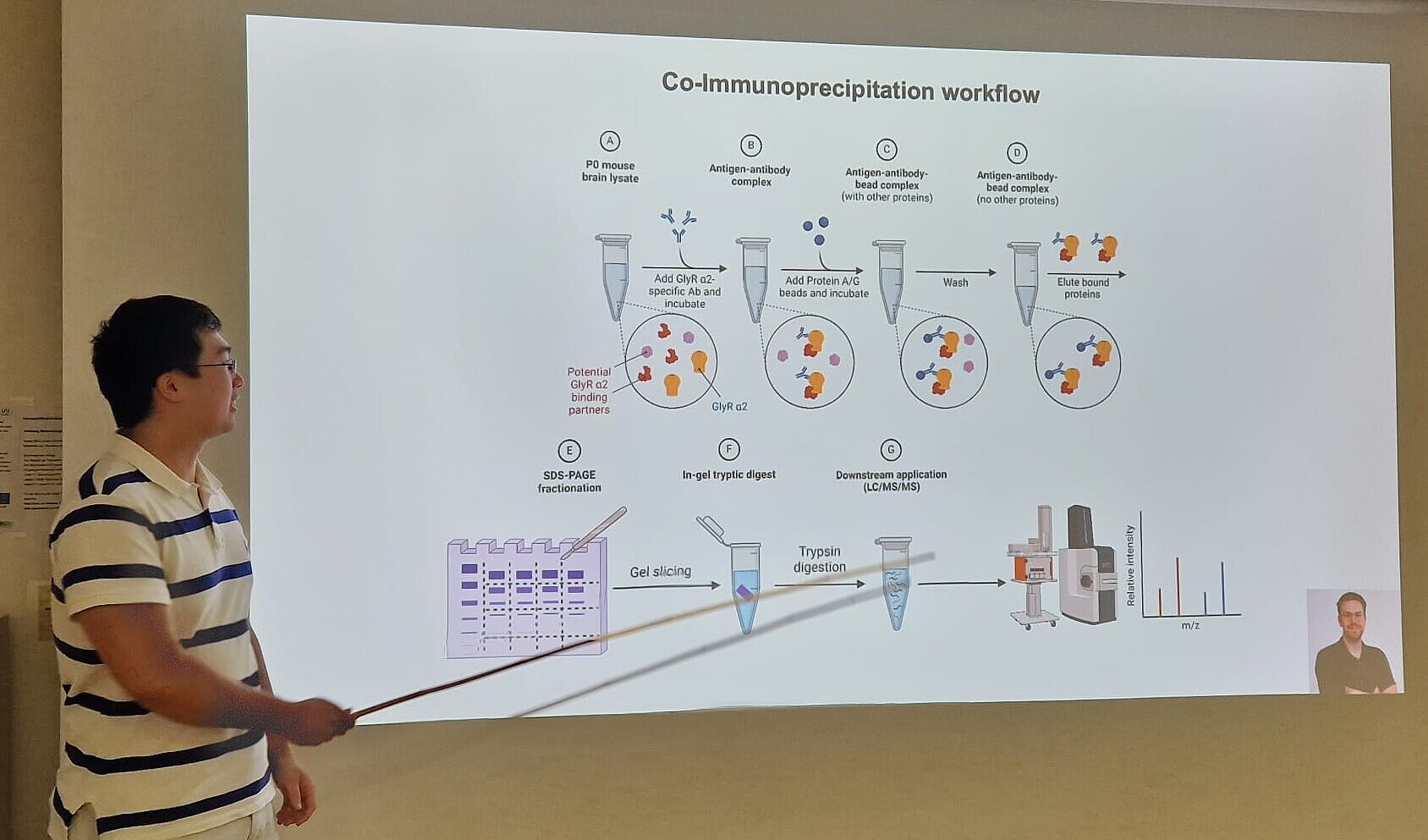
International collaboration is not only about combining scientific expertise but also about training the next generation of researchers. As part of the project, UniSC PhD researcher John Qi is currently visiting Würzburg to learn advanced cell culture, immunostaining and microscopy techniques in the laboratories of PD Dr. Natascha Schäfer and Professor Carmen Villmann. Together with his supervisor, Professor Robert J. Harvey, he reflects on the value of international collaboration, the promise of artificial synapse models and the importance of learning across continents.
From your perspective, what makes this exchange at University Hospital Würzburg particularly valuable for your doctoral researcher’s development?
Professor Robert J. Harvey: John is a new PhD student working on the proteomics of glycine receptors, the chance to work with Dr Natascha Schaefer and Prof Carmen Villmann, two experts in the field, is a fantastic training opportunity.
What motivated you to spend this period of your PhD at University Hospital Würzburg, and what are you most looking forward to during your stay?
John Qi: I was motivated to not only learn about new technologies and techniques, but also the chance to perform science outside my own lab group. This allows me to gain both new perspectives as well as ideas that may be different to those from my own laboratory in the University of the Sunshine Coast.
During your time here, you are gaining experience with new cell culture methods. Which techniques or insights are you especially interested in taking back to Australia, and how do you expect them to shape your future research?
John Qi: I hope to bring back both advanced immunostaining and microscopy techniques to my lab in Australia. While we already have access to some of these approaches and equipment, gaining hands-on experience with these methods in a different research environment will allow me to further refine my technical skills and understand their practical applications. This experience will give me greater confidence in implementing and troubleshooting these techniques in my own research, and if future opportunities arise, I will be better positioned to transfer and establish these methods within my laboratory. These skills will strengthen my ability to investigate cellular mechanisms underlying neurological disease and expand the experimental approaches available in my research program.
Which skills or experiences do you hope your doctoral researcher will gain during his time abroad, and how will these contribute to his PhD project?
Professor Robert J. Harvey: John will benefit from working in a well organised international multidisciplinary laboratory, and learn advanced cell culture and microscopy methods.
The joint project uses human cell models and 3D-printed artificial synapses to better understand neurological diseases. If you had to explain to a non-expert how an artificial synapse is created, what are the key components, and what makes it a "functional" synapse?
John Qi: An artificial synapse is created by engineering cells so that one cell displays the proteins needed to encourage a nerve cell to form a connection. Rather than relying on the complex environment of the brain or spinal cord, we use human cells grown in a controlled laboratory setting and modify them to express specific proteins involved in neuronal communication. This allows us to recreate aspects of synapse formation and function in a simplified system. By using these models, we can investigate how disease-associated changes affect neuronal development and communication, helping us better understand the causes of neurological disorders and identify potential therapeutic strategies.
Many people associate cell culture research with a Petri dish. What can the artificial 3D synapse model achieve that traditional cell culture systems cannot?
John Qi: It can help us understand how synapses and neurons behave in a 3D environment compared with traditional 2D culture systems. Some disease models do not show obvious abnormalities when studied in a 2D environment, but these defects may become more apparent when cells are grown in a more physiologically relevant 3D setting. Additionally, some disease-associated neurons may not develop, mature, or form connections efficiently in 2D cultures compared with 3D environments. By using 3D models, we can better replicate the complexity of the nervous system and gain a more accurate understanding of disease mechanisms.
The project combines human cell models with 3D-printed artificial synapses. What is the added scientific value of this international collaboration for advancing this research?
Professor Robert J. Harvey: The benefit of this collaboration, funded by the Queensland–Bavaria Collaborative Research Program, is the combination of expertise in receptor biology and interacting proteins (UniSC Australia) and advanced cell culture methods (University Hospital Würzburg). We hope to generate the first ‘animal free’ artificial synapses using iPSC cells, making this method more accessible to other international research laboratories.
How do you support your doctoral researchers during international exchanges, and what do you see as key factors for a successful stay abroad?
Professor Robert J. Harvey: Placing them in a great host laboratory with expert scientists is key. We have regular check-in meetings throughout the stay to keep the project on track, but appreciating the opportunity to travel and stay in another country is also important. I understand that John has been busy exploring Würzburg and Erlangen with expert guides in his spare time.
Outside the lab, what have you particularly enjoyed exploring in Würzburg and the surrounding region during your stay?
John Qi: I am excited to experience the local food and culture during my time in Germany. I particularly hope to explore the surrounding areas of Würzburg, including cities such as Erlangen and Bamberg, while trying the regional cuisine and experiencing the unique traditions of each area. As I have never visited Würzburg before, I also look forward to exploring some of its most iconic landmarks, including the Würzburg Residence and the Old Main Bridge, which I have heard so much about. These experiences will allow me to better appreciate the history, culture, and community of the region during my stay.
Looking ahead, do you see potential for continuing or expanding this collaboration between your institution and Würzburg?
Professor Robert J. Harvey: Given the longevity of the relationship between UniSC and the University Hospital Würzburg, I can only see opportunities for expansion of our activities. We will also host Dr Schaefer and her PhD students at UniSC later this year and next year, which will provide opportunities for training in advanced molecular biology methods. During this time, Dr Schaefer will also attempt her first ever Ultramarathon - the Blackall 50. I'll be guiding her along 50 km of hiking trails in the Sunshine Coast hinterland — with an elevation gain of 1,580 m. Whether in the laboratory or on the trails, this enduring partnership continues to push boundaries and foster meaningful global connections.